

Birthe Menke, PhD, spoke at Destinationscamp 2026 in Brixen on why destination management organizations should invest in building futures literacy before adopting data monitoring tools and risk dashboards. This blog article recaps her talk and describes 4strat’s approach to building competences in futures and foresight that can help tourism destinations stay relevant in times of change.
With a background in design research, futures studies, and sustainable tourism development, Birthe leads our strategic engagements with tourism actors and destinations. Her approach is to help tourism organizations build capabilities in futures thinking and participatory anticipation. Part of the conversation is often the tension between what we want to know about the future, what we think data can tell us about the future, and how much we’re willing to initiate a process of change in organizational thinking and planning.
We’re encountering the same expectations from destination management organizations (DMOs) as from other organizations aiming to be more conscious about their strategic decision-making: Build a data platform that provides early signals of change, maximize automation for quick check-ins when decisions need to be made, and present the results on lean dashboards with standardized decision thresholds.
The desire to exercise more control by means of automation is understandable, especially in times of unprecedented challenges that are accompanied by an increasing availability of data which should support better planning and decision-making. COVID-19, the lasting energy crisis, continuing protests against overbearing tourism systems, climate extremes – they all have intensified the demand for systems that promise orientation in an increasingly complex world.
4strat does offer risk identification and monitoring tools that include dashboards and build on proven foresight frameworks; and all of these do constitute strategic infrastructure to support proactive destination management. Nevertheless, we believe that active risk management and proactive destination management start when organizations begin considering farther time horizons, question their own assumptions about the future, and collaboratively construct images of alternative futures with their stakeholders.
A foundational resource for this type of strategic thinking is Futures Literacy. Only when those involved in strategic planning understand that ‘the Future’ consists of a multitude of alternative development pathways that emerge as interrelated political, societal, environmental, economic, and technological dynamics—each with their own uncertainties and risks—can proactive decision-making begin. And only when decision-makers manage to integrate qualitative images of possible futures with quantitative dimensions that indicate plausible development directions and trigger real-life actions, can data dashboards and other quantitative instruments actually take effect.
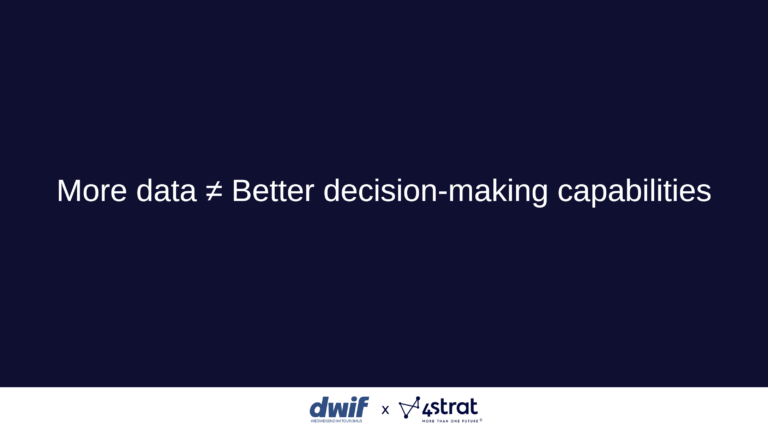
The Dashboard Paradox
A risk dashboard tracks how those parameters shift over time that are known to be a challenge or threat and thus already measured in quantitative terms, such as climate data (long term), supply chain indicators (mid-term), or booking capacities (short term). However, a risk dashboard does not challenge the assumptions based on which those parameters were selected, and it does not point to issues and emerging uncertainties that are not yet understood or quantifiable but might become risks in the future. And lastly, a risk dashboard does not surface development pathways that fall outside existing mental models.
There is a further limitation that tends to receive less attention: A dashboard does not generate the organizational conditions under which a new approach to strategic thinking that actively embraces working with risks can take root. Adopting futures thinking in an organization requires buy-in, and it requires what might be called cognitive safety, meaning a shared confidence that engaging with uncertainty, ambiguity, and competing plausible futures is a legitimate and productive mode of working.
Thinking about the future in the plural is, at first, unsettling. It asks people to let go of familiar frames of reference and to sit with the recognition that several development trajectories, some of them contradictory, may be equally plausible at the same time. A monitoring tool cannot produce that readiness. It emerges through participatory processes in which people think through scenarios together, discuss their related uncertainties and risks, make their own assumptions explicit, and come to experience ambiguity as a productive starting point for strategic action rather than a problem to be eliminated.
Without this foundation, the data dashboard tends to meet one of two fates. It is either dismissed because it does not fit the prevailing mental model of how the destination’s environment works, or it is absorbed into a linear extrapolation of current circumstances because that is the only interpretive frame available. In both cases, the strategic purpose of the tool is lost.
This points to a structural issue that affects many DMOs – the prevailing planning logic still treats the future as singular. Organizations look for forecasts, the next big trend, the most probable trajectory. That orientation is deeply embedded in how tourism planning has operated for decades, and it is reinforced by the very design of most dashboards, which present single parameters and threshold values rather than branching possibilities. The result is a paradox in which the tool that is meant to prepare an organization for an uncertain future reinforces the assumption that the future can be reduced to a single expected path.
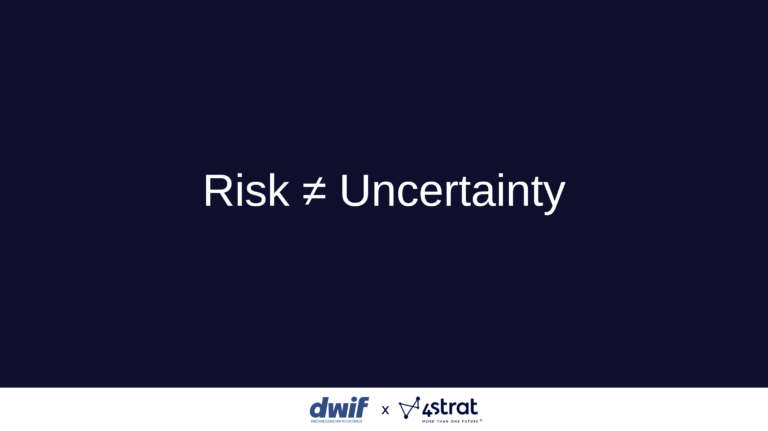
The Difference between Risks and Uncertainties
Part of what sustains this paradox is a conceptual conflation that runs deep in organizational practice, namely the tendency to treat risk and uncertainty as interchangeable terms. In most strategic planning contexts, and certainly in the language of dashboards and monitoring systems, the two are often used as if they referred to the same condition.
The economist Frank Knight established the distinction a century ago, and it remains foundational: Risk describes situations in which the range of possible outcomes is known and probabilities can be assigned to them; Uncertainty describes situations in which neither the full range of outcomes nor their likelihood can be determined in advance (Knight, 1921).
A dashboard is built for the domain of risk. It tracks predefined variables, flags deviations from expected ranges, and alerts decision-makers when thresholds are crossed. That logic works well for operational monitoring, such as seasonal demand fluctuations, occupancy rates, price sensitivity—where the parameters are established and historical patterns provide a reasonable basis for projection.
But the strategic challenges that tourism destinations now face are, in large part, not risks in this technical sense but rather structural uncertainties. The question of how geopolitical realignment will reshape travel flows over the next decade, how generational value shifts will alter what destinations are expected to provide, or how cascading climate impacts will interact with infrastructure vulnerabilities. And these do not lend themselves to predefined thresholds. Their defining characteristic is that the relevant variables, their interactions, and their trajectories cannot be fully understood in advance, which means that their future trajectory remains genuinely open and warrants the exploration of multiple future scenarios.
When organizations conflate risk and uncertainty, they tend to respond to genuinely uncertain conditions with tools designed for calculable risk. The dashboard becomes a proxy for strategic preparedness; as if monitoring enough indicators must mean we are ready. But monitoring known parameters, however comprehensively, does not prepare an organization for developments that emerge from the interaction of forces it has not yet learned to see as connected.
This is where the conversation shifts from what we can measure to how we think about what we cannot yet measure – and that shift is, fundamentally, a question of how organizations relate to complexity.
Embracing Complexity in Strategic Planning
The tourism industry is shaped simultaneously by demographic change, technological disruption, geopolitical instability, climate change, and many more major global forces. The current ETC report Futureproofing European Tourism produced by the European Tourism Futures Institute describes this environment as “complex, dynamic and rather unpredictable” (European Travel Commission, 2025, p. 48) and emphasizes that conventional planning models are no longer adequate for this degree of complexity.
The EU Foresight Report 2025 by the European Commission argues along similar lines, stating that policy decisions must be conceived “beyond the short- and mid-term political cycles,” and their robustness must be tested “under divergent future scenarios” (European Commission, 2025, p. 24).
The Bavarian scenario study on tourism in 2040 puts it pointedly: While extrapolation works for short-term, narrowly defined questions, using it for strategic foresight resembles driving along a winding mountain road with the windshield taped over and eyes fixed on the rearview mirror (Bayerisches Zentrum für Tourismus, 2021, p. 6).
The consequence is that those who seek orientation in a complex, dynamic environment must learn to work with ambiguity rather than resolve it. Complexity cannot be reduced by a better dashboard. It requires a different way of thinking.
Futures Literacy as a Key Organizational Competence
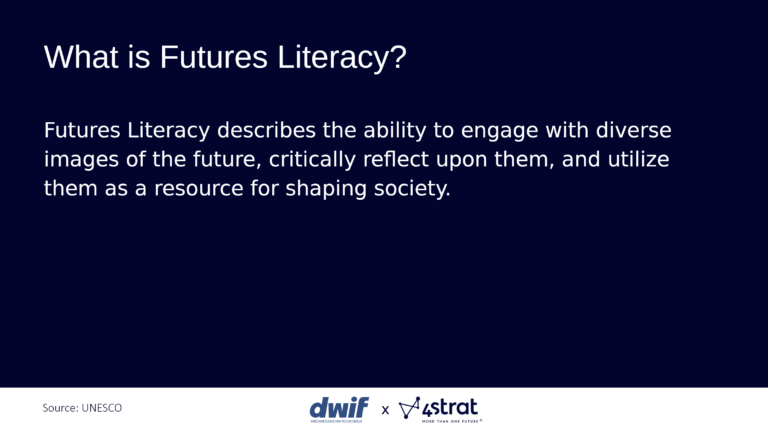
Every organization uses the future. It is present in every budget projection, every strategy paper, and every investment decision. But in most cases, this use is unconscious. Organizations default to a single anticipated trajectory, typically an extrapolation of recent experience, adjusted for a few known trends, and treat it as though it were the future rather than one version of it. Futures Literacy, as conceptualized by Riel Miller in the context of UNESCO’s global initiative, is the capacity to become aware of how and why we rely on assumptions about the future and to deliberately vary those assumptions in order to serve different strategic purposes (Miller, 2018).
Futures Literacy does not mean predicting the future more accurately. It means understanding that every act of planning contains implicit assumptions about what will change, what will remain stable, and how different forces will interact – and that these assumptions can be made explicit, examined, and diversified.
A futures-literate organization knows that a probable future (what current evidence suggests is most likely), a possible future (what could happen if conditions shifted in unexpected ways), and a preferable future (what the organization would want to work towards) are three distinct objects of strategic thinking that require different methods and yield different kinds of insight (OECD, 2018; Voros, 2017). It also understands that none of these is “the Future” but rather a structured use of anticipation that illuminates different dimensions of the present.
Peter Bishop and Andy Hines underscore that this capacity does not develop incidentally. It is a learnable, structured discipline that organizations must build deliberately through systematic practice, shared reflection, and the repeated exercise of questioning one’s own assumptions about how change works (Bishop & Hines, 2012).
This is where Futures Literacy connects directly to the challenges of complexity, uncertainty, and risk outlined above. An organization that has developed this competence is equipped to make a critical distinction: It can identify which aspects of its operating environment are amenable to risk management (quantifiable, monitorable, bounded) and which aspects constitute genuine uncertainties that require scenario thinking, horizon scanning, and qualitative exploration of alternative development pathways. It can hold multiple plausible futures simultaneously without collapsing them into a single forecast, and it can recognize emerging patterns that do not yet register in any predefined indicator system as potentially consequential rather than dismissing them as noise.
This is also the point at which the relationship between Futures Literacy and quantitative tools becomes productive rather than paradoxical. An organization that understands its environment as a landscape of multiple plausible futures, shaped by interacting political, societal, environmental, economic, and technological dynamics, can use a dashboard not as a substitute for strategic thinking but as one input among several. The indicators on the screen gain meaning when they are situated within scenarios, interpreted against qualitative images of possible development directions, and evaluated in terms of which future they might be signaling. Without that interpretive framework, the same data remains inert.
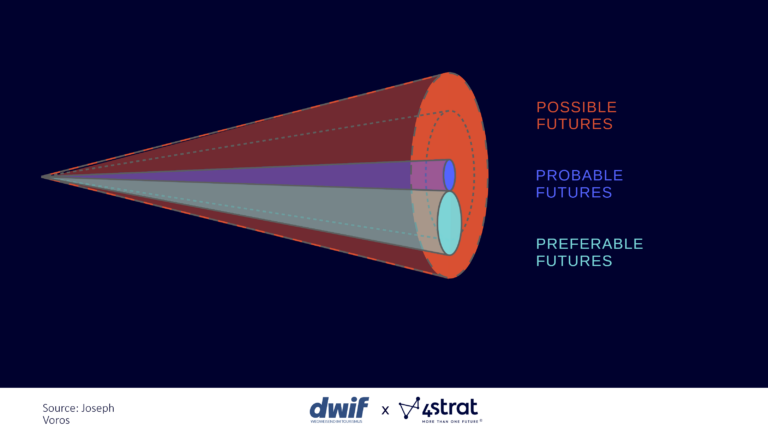
What This Means for DMOs
The argument of this article can be distilled into a practical sequence. Before investing in dashboards, indicator systems, or automated early warning tools, destination management organizations should establish three foundational capabilities:
- The ability to think about the future in the plural and to work with multiple plausible development pathways simultaneously
- The capacity to distinguish between calculable risks and genuine uncertainties and openly explore the trajectories that they might entail
- The organizational willingness to integrate futures thinking into recurring planning and decision-making processes.
These are concrete, buildable competences, and they determine whether technical monitoring infrastructure will generate strategic insight or remain underutilized.
Building Futures Competences for Destinations
This is where our collaboration with dwif Tourismusconsulting comes in. Together, we offer a dedicated Strategic Foresight program for DMOs that builds organizational foundations and introduces quantitative tools only once the conditions for their strategic use are in place.
Our process is structured in three phases:
In the first phase, we conduct a systematic trend (or risk) and environmental analysis that identifies and evaluates the driving forces, weak signals, and emerging developments relevant to your destination. All findings are consolidated on the 4strat Trendradar, which serves as a shared knowledge platform throughout the engagement.
In the second phase, we work with decision-makers, DMO teams, and regional stakeholders to develop scenarios as participatory narratives of alternative futures that make the plurality of possible development pathways tangible and open up new spaces for strategic thinking.
In the third phase, we translate these futures into concrete implications for the present, such as strategic options, innovation fields, and shared narratives that provide direction and purpose for collaborative destination development.
The goal is not to deliver a one-off study but to build lasting capacity. By the end of the process, the curated trend radar (or risk radar) is handed over to the DMO as a curated tool for ongoing strategic foresight, and participants are equipped to continue scanning, reflecting, and updating their strategic orientation independently.
dwif brings decades of experience in destination management and tourism consulting to this collaboration, while 4strat contributes expertise in strategic foresight, futures thinking, and participatory anticipation. Together, we accompany destinations from initial awareness-building through scenario development to the implementation of foresight as a strategic practice.
If you are interested in exploring what a Strategic Foresight process could look like for your destination, get in touch with Birthe Menke, PhD.
References
Bayerisches Zentrum für Tourismus (2021). Szenarien für den Tourismus in Bayern im Jahr 2040: Impulse für die Touristische Zukunft
Bishop, P. C., & Hines, A. (2012). Teaching about the Future. Palgrave Macmillan London. https://doi.org/10.1057/9781137020703
European Commission (2025). Foresight Report 2025. Resilience 2.0: Empowering the EU to Thrive Amid Turbulence and Uncertainty
European Travel Commission (2025). Futureproofing European Tourism Through Scenario Planning and Strategic Foresight
Miller, R. (Ed.) (2018). Transforming the Future: Anticipation in the 21st Century. Paris: UNESCO/Routledge
OECD (2018). Analysing Megatrends to Better Shape the Future of Tourism. OECD Tourism Papers, No. 2018/02. OECD Publishing, Paris. https://doi.org/10.1787/d465eb68-en
Voros, J. (2017). The Futures Cone, use and history. https://thevoroscope.com/2017/02/24/the-futures-cone-use-and-history/