Technology Management
With the help of our Technology management module, organizations can effectively manage their technological fundamentals to generate a competitive advantage.
Benefits of Trend Management Software for Companies
AI agents make it possible to uncover technological developments at a very early stage—far earlier than would be possible manually. This gives companies valuable time advantages to strategically assess technologies and build competitive edges.
The FSC processes extensive data from news, publications, markets, and research and presents it in clearly structured analyses. Analysts can make more informed decisions and assess technology maturity levels significantly more efficiently.
With the help of the FSC, experts identify weak signals, technological leaps, and potential disruptions that traditional scouting processes often overlook. This integrated signal detection significantly enhances the quality and depth of the entire technology scouting process.
Artificial intelligence links expert knowledge with data patterns, creating a shared, data-driven decision-making foundation. This enables teams to collaborate more efficiently and evaluate technological trends holistically.
The FSC supports compliance with security and regulatory requirements by protecting sensitive information and transparently documenting analysis processes. Companies benefit from reliable evaluations and reduced risk.
Identify technology fields
-
1IDENTIFY TECHNOLOGY FIELDSDetermine fields of technology and derive technologies.
-
2EvaluateEvaluation and assessment of technologies with internal and external experts.
-
3Analyse stakeholderConduct market analysis and identify stake holders and start-ups and assign them to technologies.
-
4Design technology roadmapDesign a technology roadmap and link it to resources and markets.
-
5MONITORINGObserve and analyse technological developments and stakeholders/start-ups.
-
6AdaptUpdate and adapt the technology roadmap.
What is Technology Management?
Today’s world is more dynamic and complex than ever, shaped by profound changes across nearly all societal spheres. Technological developments are among the most influential drivers of recent years—they shape our everyday lives as well as companies’ long-term technology strategies. At the same time, development cycles of new technologies are rapidly shortening.
To identify future technologies and their impacts early on, assess them reliably, and leverage them for organizational transformation, technical expertise alone is no longer sufficient. Instead, it requires comprehensive evaluation that accounts for sociocultural factors, market dynamics, political systems, and the responses of users and media.
The Foresight Strategy Cockpit Technology Management Module
The Foresight Strategy Cockpit consolidates the entire technology management process into a web-based software solution. The FSC enables users to integrate and share their expertise, evaluate developments, and generate patterns by linking insights. In addition, the FSC includes an indicator and patent database as well as access to monitoring features for real-time tracking of technological developments.
AI-supported Technology Management & Technology Scouting
Given the rapidly expanding technological possibilities and global innovation dynamics, traditional technology scouting is no longer sufficient. Modern technology management systems like the Foresight Strategy Cockpit use artificial intelligence to identify technological developments from diverse sources, evaluate technology maturity levels, and reveal opportunities and risks at an early stage.
The combination of structured technology management and AI-driven analysis elevates technology scouting to a new level:
- Agents continuously scan broad technological data landscapes—from patents and research findings to market and competitive information.
- They detect weak signals, technological leaps, and possible disruptions that may become relevant for companies, their target groups, and other stakeholders.
- Analysts receive a data-based foundation to evaluate technologies more quickly, define priorities, and derive effective strategies.
- Integrated security and compliance mechanisms ensure that sensitive research and corporate data remain protected and that AI analyses are trusted by stakeholders.
This results in a new form of technological intelligence that enables companies to identify relevant technologies early, make informed decisions, and systematically expand their innovation advantage.
The core of every technology management process lies in the interaction between experts and data. However, the term “expert” is often interpreted too narrowly. In a holistic technology management approach, every unit within a company has valuable insights and data that should be captured, shared, and used according to clear criteria. Instead of working in data silos, information and expertise must be exchanged and systematically integrated.
To meet these requirements, we developed a software- and data-driven concept with the Foresight Strategy Cockpit (FSC) at its center.

With the FSC, the effort required to analyze technological developments is reduced to a minimum while the implementation of efficient workflows is supported. Through the holistic integration of qualitative information, external expert knowledge, and data-driven insights, every unit of an organization can contribute to the evaluation of relevant technological trends and developments—while supporting their respective goals. All generated insights can be exported as ready-made reports (e.g., .docx or .pdf) at the push of a button.
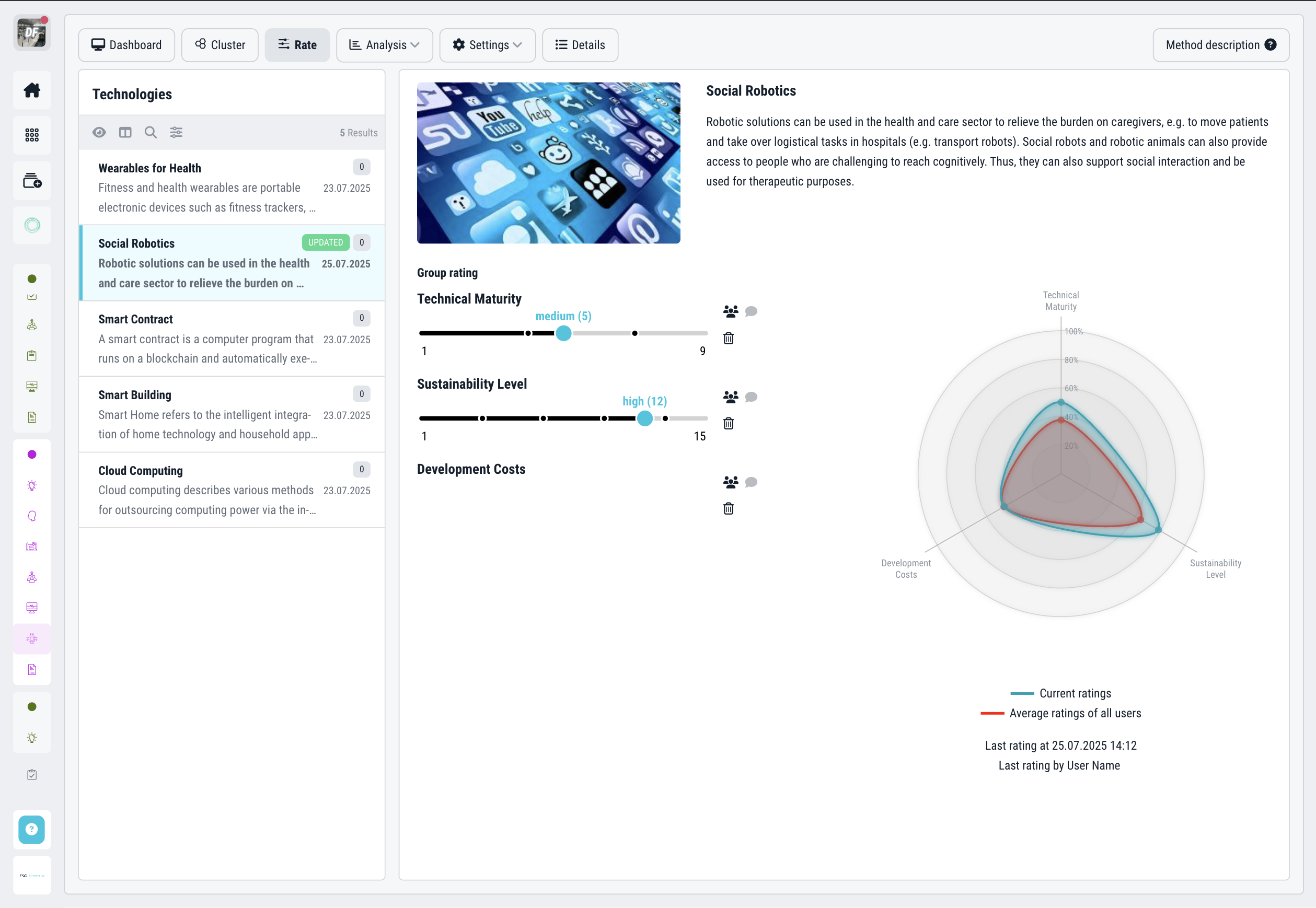
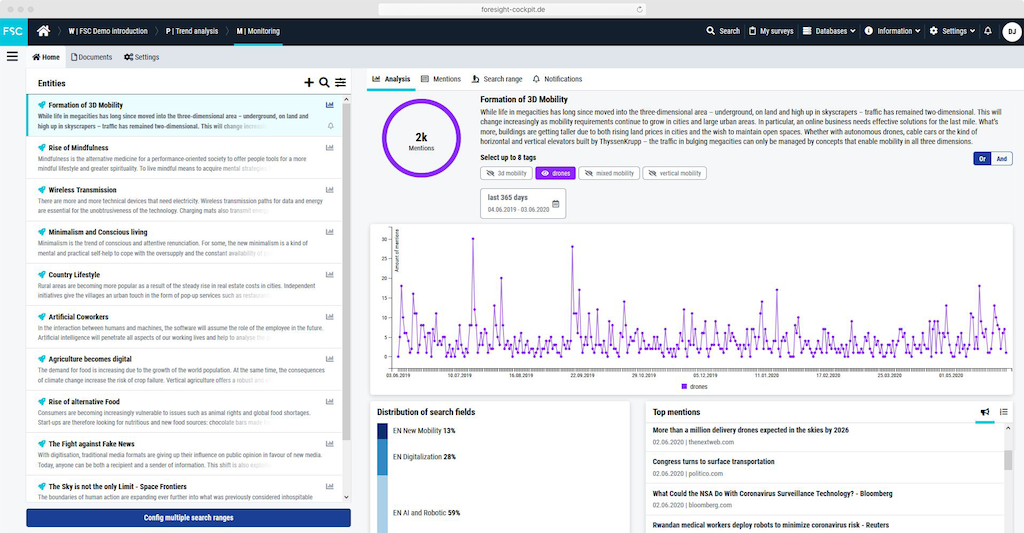
Alongside human expertise, data-driven knowledge forms the foundation for tracking technological developments and achieving strategic goals. The FSC provides access to indicators, publications, and monitoring functions to observe the development of technologies in real time and incorporate them into technology-related processes. All gathered information can be linked and harmonized.
Further features
Our values in short
Through strategic foresight methods such as Trend Management and Scenario Construction, we can reduce the complexity and uncertainty of a rapidly changing globalized world.
Designed for your team to create futures
Summary
The development of new technologies and the improvement of existing ones will continue to gain importance for companies’ market success. With the Foresight Strategy Cockpit, users can contribute their potential to technology management more easily.
Technology management serves as a precursor and accompanying process to innovation management, as both areas drive opportunities and innovation within companies.
Technology Management as a factor at all levels?
Optimizing existing processes and products is crucial to unlocking the potential of forward-looking structures and strategies. Technology remains a central factor for market success, and without innovation capabilities, companies cannot survive in the long run. Especially in times of rapid change, effective technology management is indispensable.
Systematic Technology Management
In the Foresight Strategy Cockpit, technology management unfolds in several stages: First, technology areas are identified, analyzed, and trends are detected early. Experts evaluate technologies, and a market analysis reveals potential use cases.
Afterwards, a technology roadmap is developed, while the FSC supports monitoring, analyzing, and adjusting the technology strategy. Successful technology use requires the involvement of many stakeholders, whose knowledge is captured and processed in a structured way within the FSC.
Integration of all relevant data and sources
In the FSC, expert knowledge is complemented by data on indicators and publications, making requirements in technology development visible at an early stage. This allows suitable solutions to be identified and technologies to be deployed in a targeted manner. Each solution found supports product development and strengthens the company’s long-term market success.
Frequently asked questions
A technology management software such as the Foresight Strategy Cockpit (FSC) supports the entire technology management process in a web-based environment. It helps companies efficiently track, analyze, and respond to technological developments.
The FSC combines qualitative and quantitative data, integrates expert knowledge, and provides real-time monitoring. This enables companies to stay on top of technological developments at all times and make well-informed strategic decisions.
The FSC consolidates the entire technology management process in a single software. It facilitates the identification and evaluation of technology fields, stakeholder analysis, roadmap creation, and monitoring of developments. Users can integrate expertise, conduct assessments, and link insights.
The FSC fosters efficient collaboration by reducing analysis effort and centrally integrating data and expert knowledge. This creates a holistic evaluation of technological trends. Teams can jointly generate insights, share them, and export them as professionally prepared reports.
Technology management connects management with new technologies and is essential for remaining competitive. Companies that stagnate technologically often lose innovation potential and market opportunities. Modern technologies in production, development, and digitalization are crucial for efficiency and innovation. Investments in technology development strengthen long-term innovation capabilities and secure sustainable market success.
Artificial intelligence automatically analyzes large data volumes from patents, research, market, and competitive analyses and detects patterns that would be difficult for humans to recognize. This enables companies to identify technological opportunities, risks, and potential disruptions much earlier and leverage them strategically. AI also simplifies the prioritization of technologies, supports decision-making, and increases efficiency throughout the technology management process.
Technological developments are key drivers of business success. Technology management helps detect opportunities and risks early and develop suitable strategies. This enables companies to build competitive advantages and position themselves successfully in a dynamic market environment.