Strategy Management
A strategy is a plan that includes a set of actionable measures designed to bring about a desired outcome or mitigate the effects of unfavourable developments in the future. A strategy is selected in order to achieve a long-term goal.
Benefits of Trend Management Software for Companies
Clear alignment through structured strategy planning
A strategy management software consolidates all strategic goals, actions, and priorities in one central place. This ensures that companies always maintain an overview and that all teams work toward shared objectives.
Early identification of risks and opportunities
Integrated scenario analyses and real-time data make it possible to identify potential developments early on. Companies can minimize risks and proactively seize opportunities – instead of merely reacting to change.
Efficient implementation of strategic actions
The software makes progress and responsibilities transparent, ensuring that actions are carried out on time. This increases efficiency, reduces coordination efforts, and raises the success rate of strategic initiatives.
Better decision-making through data-based analysis
Instead of relying on intuition, companies can access structured data, visualizations, and reports. As a result, decisions become more informed, transparent, and strategically effective.
Stronger competitiveness through adaptability
With a flexible strategy management software, companies can respond more quickly to market changes and adjust strategies dynamically. This builds long-term resilience and strengthens competitive positioning.
Unser STRATEGIEMANAGEMENT PROZESS
-
1Define goals and scenariosDefine your goals with the Goal-Assessment method and develop appropriate scenarios.
-
2Deriving fields of action and options for actionDerive suitable fields of action and their options.
-
3Create strategiesCreate and discuss different strategies in a team.
-
4Evaluate the strategiesCollaboratively evaluate the possible strategies against the objectives and scenarios at different time intervals.
-
5DecideUse different methods to decide which strategy is the best at what time.
-
6REPORTINGExport, share and publish the results with one click.
What is Strategy Management?
Is your strategy flexible enough to meet future challenges? We cannot predict the future, not even with the best foresight methods. However, we can help you design agile and robust strategies that allow you to react quickly and appropriately to change.
This is especially relevant in VUCA environments (Volatile, Uncertain, Complex, and Ambiguous), where disruptions often emerge with weak or barely detectable signals but have massive and unexpected impacts due to systemic interconnections. The solution is to think about potential versions of the future today in order to prepare and actively shape change.
The Foresight Strategy Cockpit Strategy Management Module
Our strategy module unites all aspects of our approach in a web-based support system. The Foresight Strategy Cockpit (FSC) allows all users to integrate and share their knowledge, as well as evaluate strategies and decision options. Strategies can be seamlessly linked with other insights.
Strategy Management with Artificial Intelligence (AI)
Artificial intelligence helps companies sharpen their vision through precise analyses and data-driven recommendations. AI facilitates the implementation of strategic actions, the identification of key factors, and the development of related projections. Strategic initiatives can be evaluated, optimized, and aligned with relevant influence factors more quickly. This makes strategy execution more efficient, more dynamic, and better suited to ever-changing market conditions.

The idea: Combine strategies with scenarios
A strategy is a plan with clearly defined actions aimed at shaping a desired future or preventing an undesired one – always with a focus on growth, flexibility, and long-term perspective.
It is selected to achieve an overarching goal and to sustainably align companies and teams. Our strategy management module offers various methods for developing and testing your strategy.
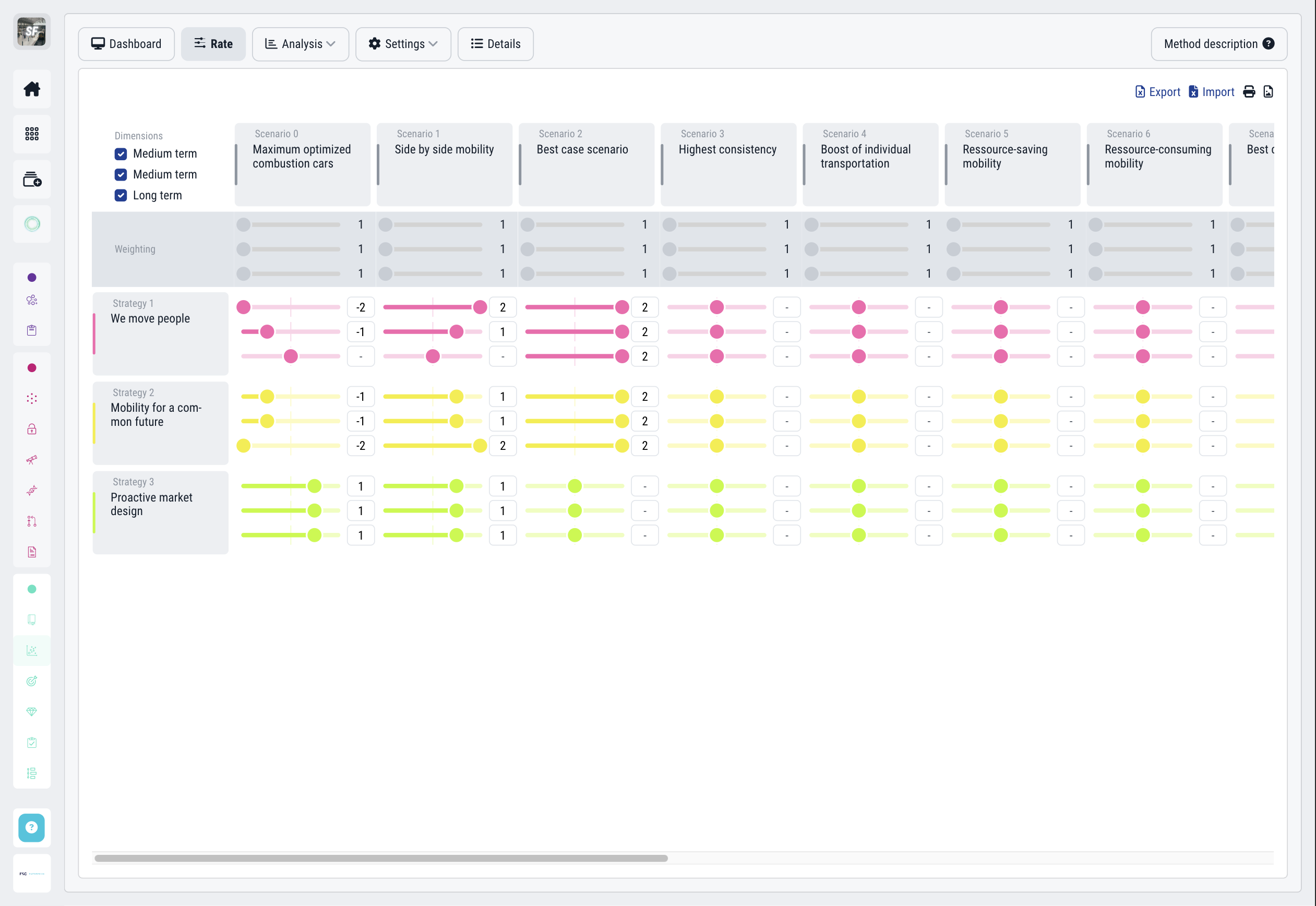
New or existing strategies are systematically compared with developed scenarios or target states and embedded into a temporal context. This allows you to identify which strategy is most effective at which point in time and when a change of strategy becomes necessary to ensure long-term growth and flexibility.
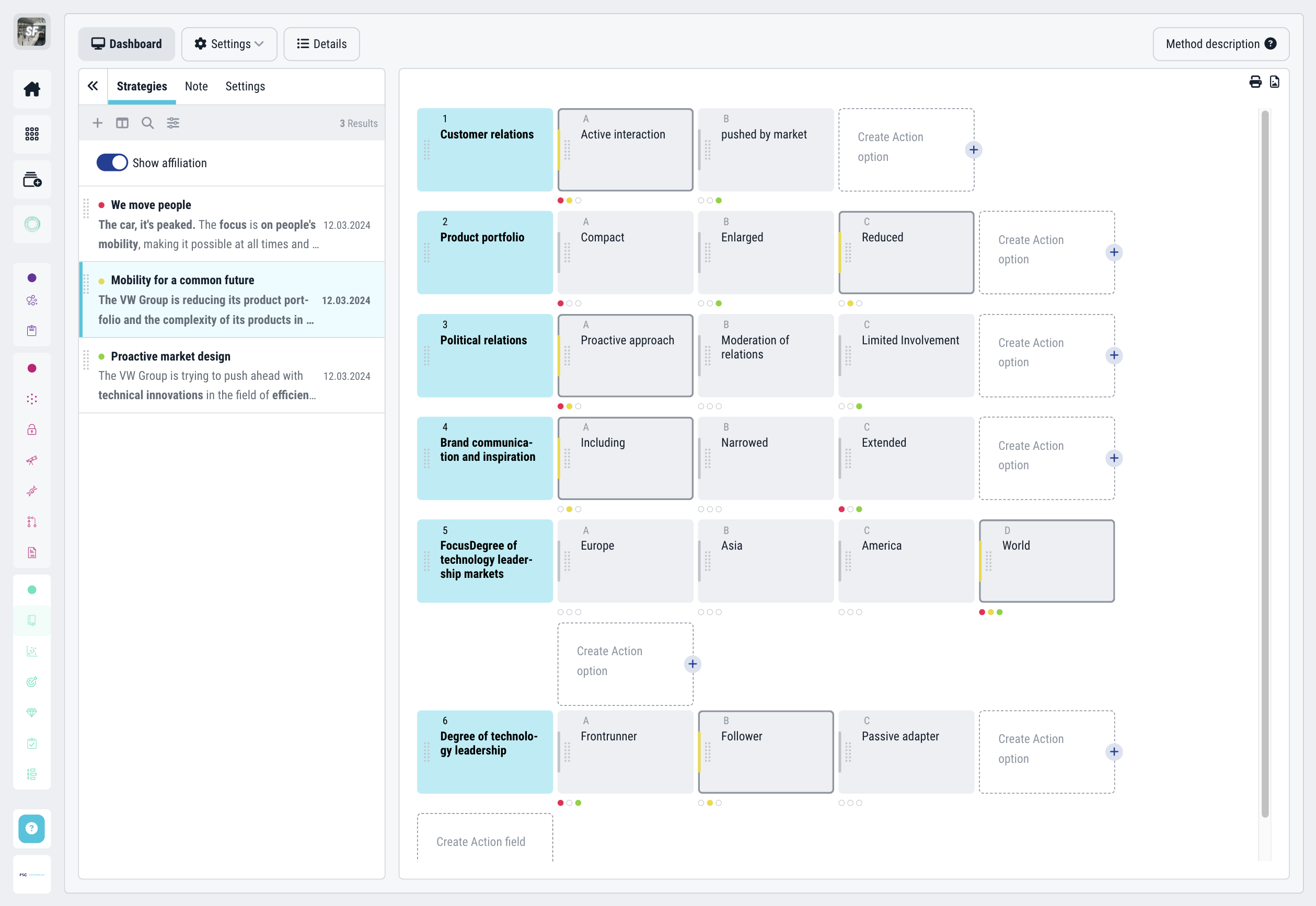
Define multiple strategies at once
During strategy definition, users create a set of action fields – areas in which the organization is active – each containing attachments, tags, and links to other entity types. Within each action field, multiple action options are defined to clearly distinguish tactical measures and plan them in line with established best practices.
By systematically combining these action options across various action fields, a transparent and efficient solution emerges that enables the development of multiple strategies simultaneously.
Test your strategies in different scenarios
Instead of relying on the future success of your corporate strategies, evaluating their performance across different scenarios or target visions is far more promising. With the help of our software solutions, teams can assess various strategy–scenario or strategy–target combinations at different points in time and identify how robust or fragile each strategy is in relation to your long-term vision and successful strategy execution.
Further features
-
Develop technology strategies that underpin your organization.
-
Forecast technological trends to stay one step ahead of the competition.
-
Map technologies to business and market needs by using our road mapping feature.
-
Combine all these methods to develop a customized technology portfolio.
Our values in short
-
Collaborative analysis of technological developments
-
Access to indicators and patent database
-
Browser Add-on and App for faster integration of relevant pieces of information
-
Real-time technology monitoring
-
Automated report functions for fast communication
-
Comprehensive support and training by our Foresight experts

FSC Modules
Through strategic foresight methods such as Trend Management and Scenario Construction, we can reduce the complexity and uncertainty of a rapidly changing globalized world.
Designed for your team to create futures
Summary
Strategy management is the central link between planning effective actions and putting them into operational practice. Every strategy pursues a concrete goal – but in a dynamic and rapidly changing environment, the demands placed on corporate strategy and management are continuously increasing.
The better you integrate all levels and processes of your organization into a holistic strategy management approach, the more resilient you become to unexpected developments.
For strategies to be effective, they must be firmly embedded into operational processes. As markets and environments become increasingly volatile, a clearly structured strategy management system provides the necessary orientation to identify and leverage relevant action options early on.
One strategy is not enough – but why?
The more precisely you integrate the different levels and processes of your organization into strategic management, the better you can respond to unexpected developments. Strategic planning must be part of operational processes, as markets and environments are becoming more dynamic. By maintaining a clear structure and an overview of available action options, you ensure that your organization remains flexible and identifies opportunities and risks early on.
Rethinking strategy management: Adaptive, data-driven, and comprehensive
Our strategy module supports you in the structured implementation of a versatile and adaptable corporate strategy. All relevant aspects of your organization are integrated, enabling you to address both internal and external challenges in dynamic markets.
The FSC provides the tools needed to identify risks early, seize opportunities, and implement strategic actions efficiently. Through the FSC’s modules and processes, you strengthen your competitiveness – even in fast-moving and constantly changing market environments.
Different scenarios – adaptable strategies
To ensure effective strategy planning, all relevant factors and levels must be systematically analyzed and consolidated within a holistic strategy management approach. This includes the company’s current state, market and industry trends, corporate policies, and mission statements.
Strategic goals, technological developments and their effects on internal processes, as well as potential future market situations, also flow into this analysis – enabling you to develop suitable strategies for different long-term business scenarios. Through continuous reporting, you keep all results in view and can integrate strategic actions precisely and efficiently into operational workflows.
Frequently asked questions and answers
A strategy management software such as our Foresight Strategy Cockpit (FSC) provides companies with a tool to plan and implement their strategic goals and measures in a structured, efficient, and future-proof way.
In a fast-paced and often unpredictable business world, companies need a clear yet flexible strategy to remain capable of acting. A strategy management software supports proactive planning, scenario simulation, and continuous strategy adaptation.
Our Foresight Strategy Cockpit goes a step further: It integrates real-time data and expert knowledge, offers a variety of visualizations, and meets the highest security standards. Through modules such as trend management and scenario construction, companies can reduce uncertainty, identify opportunities earlier, and secure decisive competitive advantages.
The Foresight Strategy Cockpit combines various modules and processes to enable holistic strategy planning and implementation. It integrates qualitative and quantitative data, enables real-time team collaboration, and takes into account both internal corporate aspects and external market conditions. This gives companies a powerful solution to stay successful in an ever-changing market environment.
An optimal strategy results from the interplay of key factors: understanding internal structures and resources, analyzing external market and environmental conditions, and clearly defining goals and priorities.
Only when these influences are evaluated holistically can actions be derived that can be effectively anchored within the organization. It is essential that strategy work is not a one-time effort but is regularly adapted to new conditions. This creates a flexible, well-founded approach that provides orientation even under uncertainty and ensures long-term success.